
The December 1986 edition of the quarterly newsletter Columbia Disc Golf News had plenty to catch a disc golfer's attention. A list of disc golf competitions across the United States, an interview with the "father of disc golf" Ed Headrick, and tips on choosing a putting style from Dave Dunipace (founder of the then three-year-old company Innova-Champion Discs) were all there.
Columbia, Missouri, locals might have been interested in notes about trees being added to an area course or the results of the recent club championship.
On the newsletter's seventh page, though, was something that's now an Easter egg of the game's history: A listing for disc golf's first-ever "Ice Bowl."
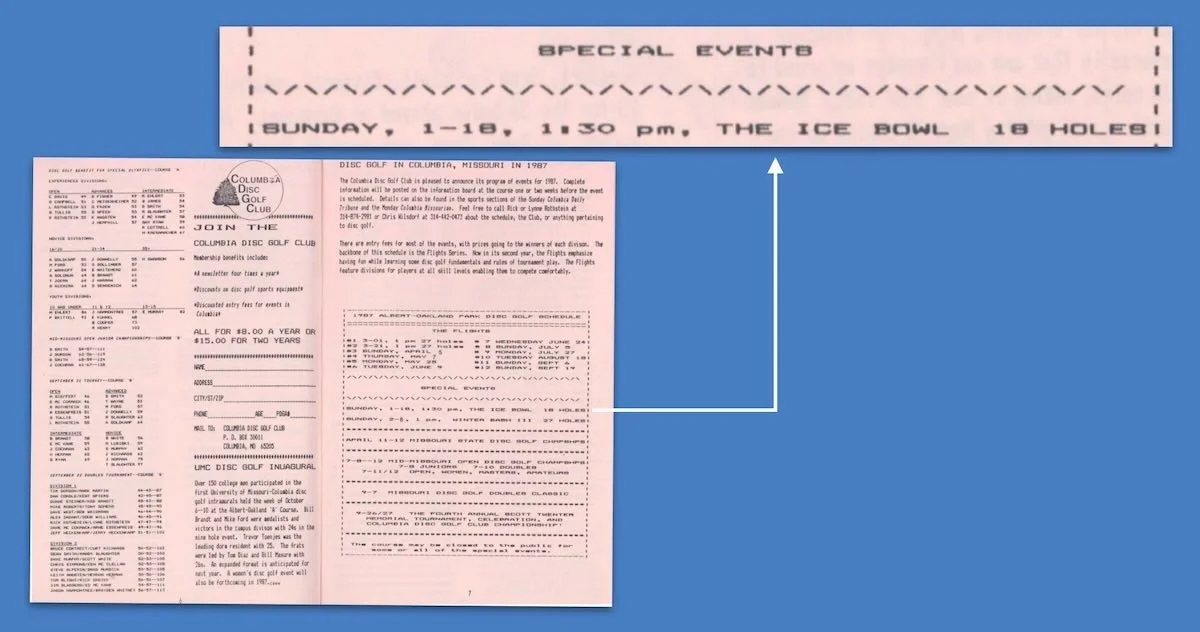
That January 1987 event was a seed that grew into something much bigger. Today, there are Ice Bowls galore in disc golf communities in the United States and Canada as well as a few outside of North America. In the early months of 2025, for example, there were 182 Ice Bowls disc golfers could choose from.
While calling a winter disc golf competition an "Ice Bowl" might seem like a convention similar to tacking "Challenge" or "Fling" to the end of a tournament name, it's not. "Ice Bowl" is a legally-protected label when it comes to disc golf, and organizers of Ice Bowls have to apply to run one. The biggest requirement for Ice Bowl events is to have their proceeds support a local or regional charity.
Rick Rothstein was the lead organizer of that first Ice Bowl and the founder of the 501(c)(3) not for profit Ice Bowl Foundation that approves events today. He's also a Disc Golf Hall of Famer and the former publisher and editor of Columbia Disc Golf News, which became Disc Golf World News in spring 1987 and stayed in print under his leadership until 2008. His dedication is a huge reason why an 18-hole tournament in 1987 turned into a charity-based franchise of disc golf events that has raised millions of dollars for those in need.
Rothstein told us all about Ice Bowls past and present as well as what he hopes for their future.
The Early Years of Disc Golf Ice Bowls
The first disc golf Ice Bowl Rothstein organized wasn't based around a charitable cause. Its goal was to get disc golfers together at a time of year when the community felt dormant.
In hopes of maximizing attendance, he picked a date for the event that strategically avoided a major scheduling conflict.
"I picked the weekend before the Super Bowl because there was no football – they did the bye week," Rothstein said.
Though Rothstein didn't want a ball game ruining his turnout, his choice of event name was a football reference.
"Ice Bowl" is the nickname for a legendarily cold and exciting 1967 NFL Championship Game in Green Bay, Wisconsin, on New Year's Eve between the Dallas Cowboys and Green Bay Packers that had a wind chill around -36° F/-38° C. Refs were unable to use their metal whistles because they'd freeze to their lips, many fans needed treatment for frostbite, and, incredibly, the day remains the coldest December 31 in Green Bay on record. Closely contested, the Packers won the game in thrilling fashion with under 20 seconds to go.
Rothstein hoped dubbing his tournament "The Ice Bowl" would awaken an urge for intrepid sporting inspired by thoughts of the famous football game, and he leaned into that theme when marketing it.
"I said, 'We will not postpone this because of weather and no wimps are allowed,'" Rothstein recalled.
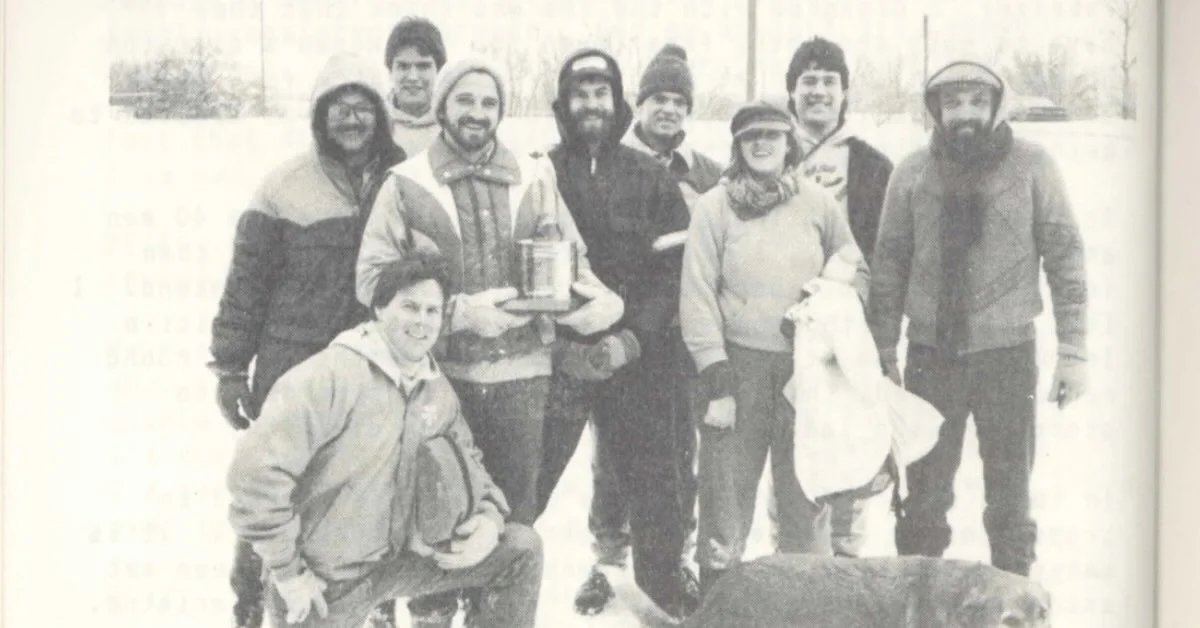
Mother Nature played her part to perfection for that first disc golf Ice Bowl on January 18, 1987. The temperature never rose above freezing at Columbia's Albert Oakland Park, assuring that a gift from the previous day stayed put.
"On the Saturday night before Ice Bowl Sunday, we had five inches [13 centimeters] of snow," Rothstein said.
Not only did the snow make the event feel more special, it provided a fantastic backdrop for photos taken by a journalist from the Columbia Daily Tribune who surprised Rothstein when he showed up to report on the tournament.
"And two days later there was a picture and maybe 20 words below the fold on the front page of the sports page!" Rothstein exclaimed, still excited about the unexpected publicity four decades later.
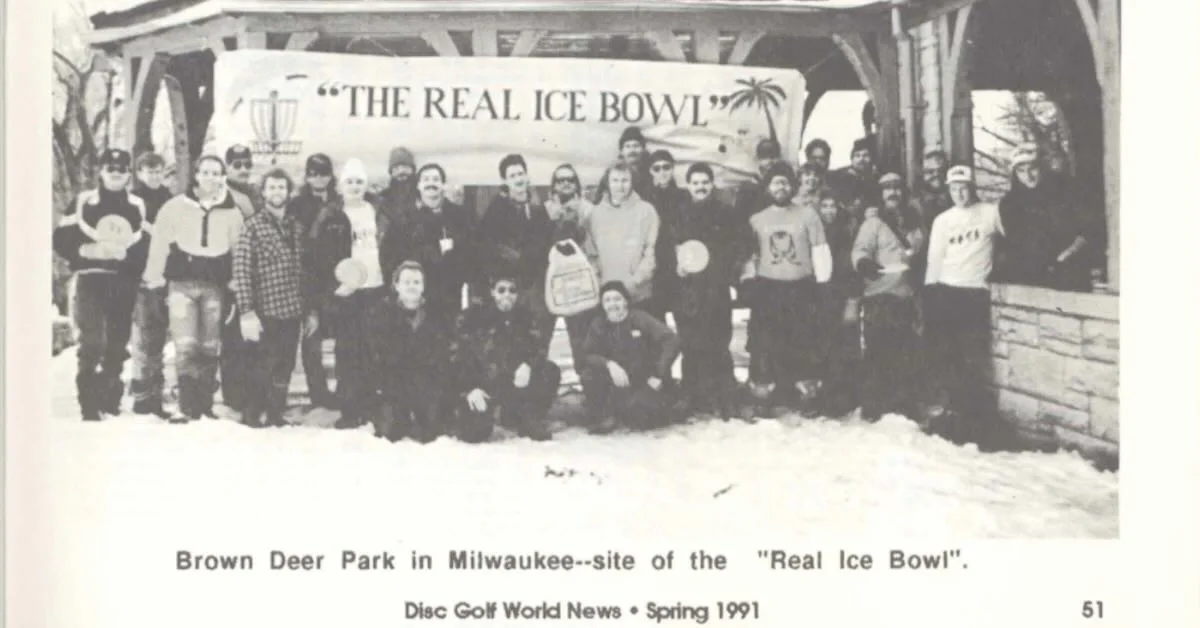
Given how small disc golf was at the time and the unpleasant playing conditions, 34 attendees felt like a respectable turnout to Rothstein. His write-up of the event in Disc Golf World News got others interested in running something similar the next year, and in January 1988, Columbia was joined by seven other cities in hosting an Ice Bowl on the Sunday a week before the Super Bowl.
From there, disc golf Ice Bowls – appropriately enough – continued to snowball, and the timeframes for holding one became less and less exact.
"From '87 to '94 we expanded the days on which we said Ice Bowls could be played," Rothstein said. "We started with Ice Bowl weekend. Then we established Ice Bowl corridor. Of course, we eventually landed at any time between the [winter] solstice and [spring] equinox."
The Charitable Aim of Disc Golf Ice Bowls
The first time a disc golf Ice Bowl had a charitable goal was in 1995 when the Indianapolis Disc Golf Club used the occasion to collect donations for a local food bank. Rothstein loved the concept and encouraged all Ice Bowl organizers to implement it.
"I thought this was a great idea and ever so slowly, probably two to three years of doing this, we were saying, 'This is part of Ice Bowl now,'" said Rothstein, referring to having events focus on charity.
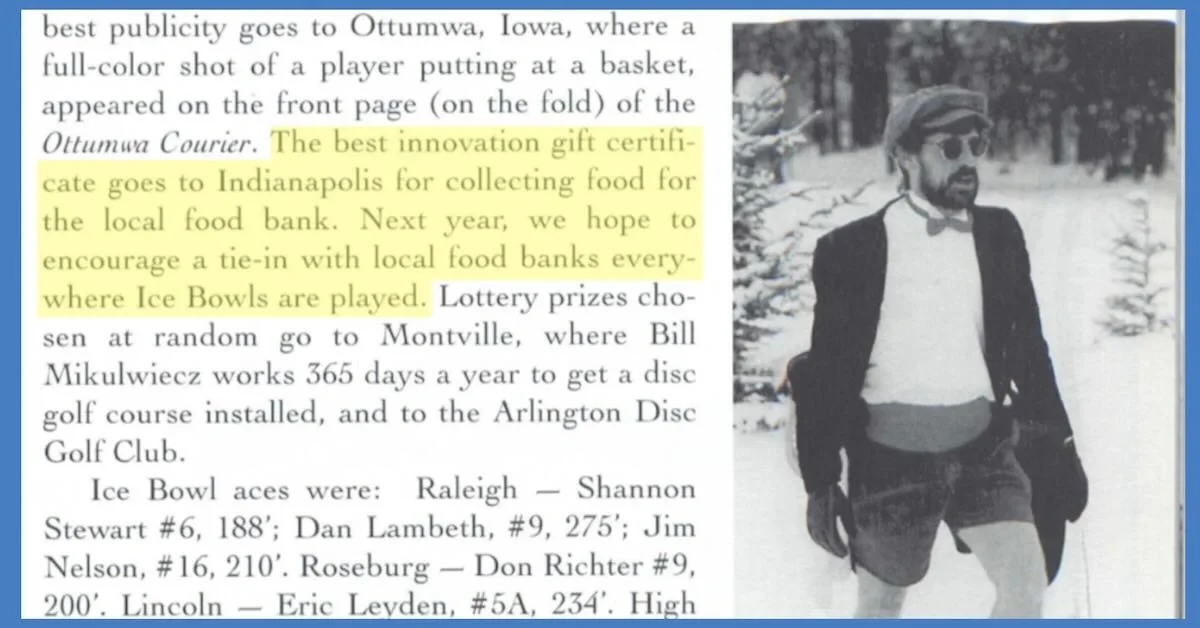
To be clear, the "Ice Bowl" name in connection with disc golf wasn't legally protected at this point. However, Rothstein was in a stronger position than most to mold the meaning of "Ice Bowl" in the disc golf consciousness thanks to his position as editor and publisher of Disc Golf World News – one of extremely few disc golf publications at the time. In 1996, he began asking all Ice Bowls to file reports about the funds they raised, attendance numbers, and weather conditions.
Local food banks became the preferred beneficiaries of Ice Bowls because Rothstein felt they were "the least controversial of charities." Additionally, Ice Bowls usually took place in January, a time when food banks typically struggled since it was no longer "the season of giving." He also saw working with local institutions as a way for disc golf to establish deeper community connections, which could only be good for the game in the long run.
Today, the Ice Bowl Foundation still encourages organizers "to choose charities that work towards eliminating or mitigating food insecurity" though they will approve events focused on other causes.
Running an Official Disc Golf Ice Bowl Today
As disc golf continued to grow, Rothstein wanted to protect the identity of charity-focused events that Ice Bowls had taken on. He applied for a U.S. trademark of "Ice Bowl" in the realms of flying discs and disc golf tournaments in 2007 that was later granted. This gave him leverage to say, in Rothstein's words, "If you're not raising money for charity, you may not run this tournament because you're infringing on our trademark unless we give you permission."
The trademark lapsed briefly in 2019 before being renewed – this time including clothes and other wearables – in 2020.
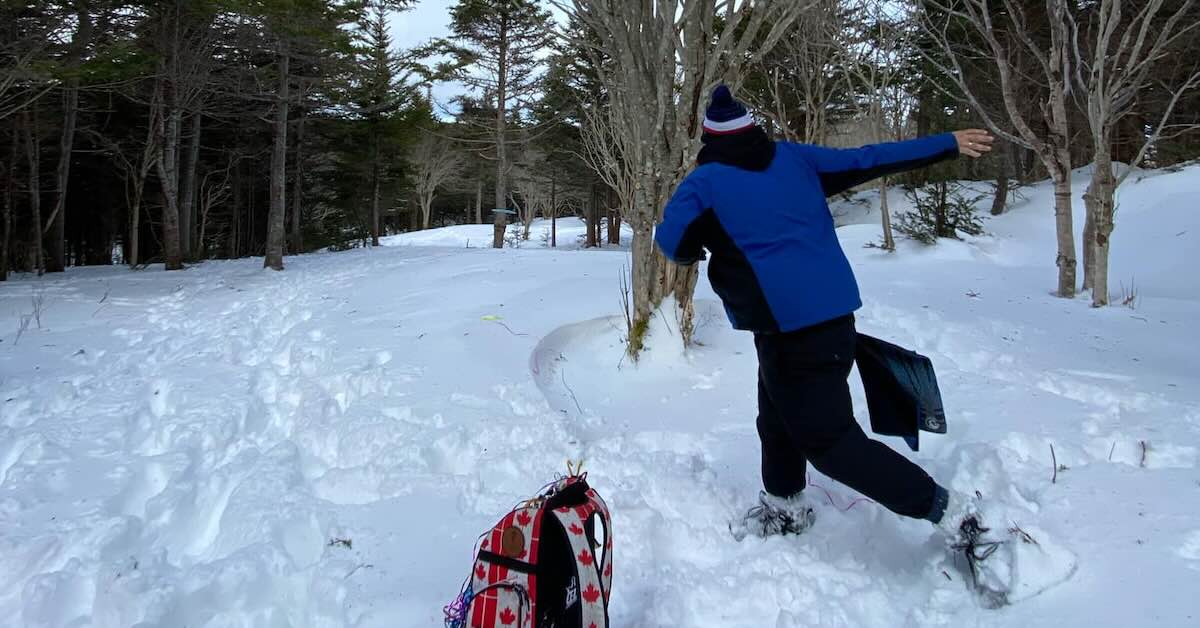
Though the name is protected, there is no fee to register an event as a disc golf Ice Bowl. Along with taking place between the dates marking the start and end of astronomical winter in the northern hemisphere, the non-negotiables for holding an Ice Bowl are filling out a registration form that identifies the benefitting charity and sending in a post-event report with player count, money raised, and weather.
The events can take any form and there's no requirement that they be competitive. In fact, the Ice Bowl Foundation encourages "less-formal, creative, and even 'goofy' formats" that favor fun over competition.
Keeping Up the Tradition
Rothstein is no longer helms the Ice Bowl Foundation though he still holds a board seat and works to promote it. When talking about his role in Ice Bowl history, his preferred term is "instigator." He believes he simply had a good idea that's since inspired dedicated disc golfers to do the hard work of organizing, advertising, and running Ice Bowls over the years.
In total, there have been over 5,600 official Ice Bowl events, and they've raised nearly $7.5 million in funds thanks to 291,197 players. This winter marks the 40th year disc golfers will have a chance to play an Ice Bowl, and Rothstein is excited to see that number just keep climbing.
"We've had a great forty years," Rothstein said. "Now we're making plans for the next 40."
To see if there's an Ice Bowl near you or to register your own event, check out the Ice Bowl Foundation's site.
